Monday, April 20, 2015

Teacher Leadership & Blooming Where You Are Planted


The past few days I've had the opportunity to dialogue with members of my PLN in a few different places about the role of teacher leaders, the inherent value of teacher leaders, and some of the struggles that go along with teacher leadership. This post is a bit of synthesis of those conversations.

Defining teacher leadership...
One of the things that I feel is both a strength, and a weakness (for lack of a better word) of teacher leadership, are the unique and flexible roles that teacher leaders can play. In some cases there are formalized positions in a school or a district, including, but not limited to committee or department chairs, instructional coaches or teachers on special assignment. Then you have the much more informal roles that can evolve, and vary, depending largely on the interest and passion of the individual teacher, and the needs of their students. These more informal roles seem to develop more organically out of the day-to-day work, and interactions of classroom teachers. Having great diversity can make it difficult to adequately define teacher leadership, and yet the implications of both forms of teacher leadership on the larger system, seems pretty clear.

Formal Teacher Leaders...
Formal teacher leaders are accomplished and respected educators. They have content and instructional expertise. Formal teacher leaders play critical roles as instructional coaches, peer coaches, facilitators of professional learning, and curriculum coordinators. Their impact on teacher practice and student learning are quantifiable. These individuals often promote evidence-based instructional practices to increase teacher expertise, student achievement and advance education reform. At their core they support student learning and teacher practice.

Informal Teacher Leaders...
Informal leaders are also accomplished and respected educators. They engage in professional learning and share it with their colleagues. Informal teacher leaders are risk takers and innovators. They conduct action research and facilitate study groups. They lead from the classroom, but much like their formal counterparts, they are looking to improve instructional practices, and positively impact and support student learning.

We Need Formal and Informal Teacher Leaders...
A couple of days ago I was discussing this same topic in some detail with Ashley Hurley. She provided some great insight. Our conversation really impressed upon me the need for both formal and informal teacher leaders, and the conclusion that one is not any more, or less important than the other. It comes down to recognizing your true purpose or mission, and that regardless of your position that you "bloom where you are planted."  This resonated with me particularly strongly, because I often find myself trying to justify my desire to lead from the classroom, rather than making the jump to a more formal teacher leader role, or to administration. As a side note, Jeff Zoul, also blogged on this topic recently (you can read it here), and it really struck a chord. What I think it comes down to is this, one calling is no more noble than the other, but that we each have a unique role that we can play, and a unique impact on the educational system as a whole. We need to appreciate those who take on the formal roles and encourage and empower others to take on the informal roles. Leaders are all around us.

Share Your Experiences!
I would like to invite you to share your experiences and thinking in the comments below. I'm very curious about how teacher leaders perceive themselves, their roles, and their impact. I would also like to hear how district and school administrators have embraced and promoted teacher leadership in different ways. There is so much we can learn from one another!

Looking to Learn More About Teacher Leadership?
There have been numerous articles and blog posts written on teacher leadership, what it can look like and potential impact. Here are some links to a few that I have found to be particularly helpful and/or interesting, not an exhaustive list by any stretch, but a place to start if you're interested.

      The Teacher as Leaders issue of Educational Leadership magazine by ASCD
      What Does the Research Tell Us About Teacher Leadership
      Three Do's and Don'ts of Transformative Teacher Leadership
      Teach to Lead: Advancing Teacher Leadership
      Teacher Leader Model Standards


Monday, April 13, 2015

Are We Too Humble?

As part of the blogging group #compelledtribe we are sharing something new we attempted in our work this year to better ourselves as educators. One of the things that I have tried, is blogging more regularly, and having the courage to put my convictions, learning and reflections, out there, in print for all the world to see. Blogging more regularly has helped me to reflect on my own learning, and to think more deeply about what truly matters in education and leadership. It has helped me to engage with others and to wrestle with some of the challenges that we face. It has helped me to recognize that there are many opportunities for educators to share their stories and the stories of their school community, and that this can be one way to impact and influence conversations about the education system. I'm not sure that we take full advantage of our sphere of influence, and it is imperative that we do. What stands in our way? Maybe we are too humble. And with that, I give you...

Are We Too Humble?

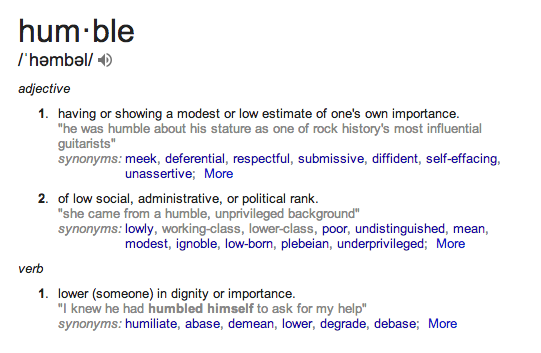
Teachers are a pretty humble lot. Most of us don't like to boast, stand in the spotlight or "toot our own horns." We quietly go about our work, and are both gracious and polite. I mean just look at the definition provided to us by Google Search...


Anything surprising? The definition seems to fit, I'm almost surprised that a picture of a teacher doesn't pop-up alongside it. I think our humility, at least in part stems from the fact that for so many of us teaching is much more than a career or profession. For many of us teaching is a vocation, a calling. Whether we chose teaching, or teaching chose us, we do it in service of others. This has had a profound impact on the professional culture, and I think it has, in part made us targets. I won't spend a lot of time in this post talking about the current state of education in this country, you can read about my thoughts regarding it, in my last post titled, Better Days. Let me be clear, I am not suggesting that we become a boastful lot, but I do think we need to challenge the idea of being humble, at least a little bit.

As noted in the definition provided by Google, humble is both synonymous with self-effacing, but it is also synonymous with meek, submissive and unassertive. This my friends, is where there is a problem. We need teacher leaders. We need educators that are bold, that are willing to stand up for the profession, advocate for students, take risks and tell the true story of education in this nation. We must do a better job of sharing our stories, the educational journeys we embark on with our students, the ways in which we have collaborated and pushed one another to innovate and improve the system, and we must celebrate the hard-work and dedication of our colleagues. If there was ever a time for meek, submissive and unassertive educators, that time has certainly passed. Now is the time for us to be bold, to speak up and speak out, and recognize our sphere of influence and the impact that we can have.

Speak Up...

I was truly honored this weekend to be nominated for a Bammy Award. The Bammy's are a powerful way that we can share our stories, support one another and celebrate all that is good in education. What is really great about these awards is that all of us can nominate our colleagues to receive recognition with the Educator's Voice Awards (learn more here). I nominated Steve Garraffo, LCSD Director for Elementary Education, for such an award. (This will take you to his nominee's page.) I think it is truly important for us to share all of the wonderful things that are happening here, and across the nation. I hope you will help spread the word, vote for some of the nominees, and nominate others. There are great things happening, and we have the responsibility to share them!


Wednesday, April 8, 2015

Better Days


If you were to listen to mainstream media, and any number of politicians, you might believe that education in our nation were in shambles. It simply isn't true. Are there struggles? Of, course. I'm not going to bury my head in the sand and pretend otherwise. The education system is not immune to society's ills, at times as a classroom teacher you see them amplified. Indeed, there are days when it seems almost too much to bear, and yet we do. We do, because teaching is more than a job. It is a deep calling, a vocation that can scarcely be put into words. We are committed to the young people, the families, the communities that we serve. We know their faces, their hearts, their stories.

There are days when I have wondered, and flat out worried about the direction of our nation. Competition, ranking, and sorting; it seems to bring out the worst in us. It is as if that we have forgotten that we are all ultimately connected to one another, and bound to one another. We have forgotten that for us to prosper as a nation requires collaboration, far more than it does competition. We must do better. There needs to be less isolation, and more connection. We must acknowledge our shortcomings, and look far and wide for ways to improve, we may have to admit that we don't have all the answers, and we need to be willing to make mistakes. We need to embrace curiosity, and cultivate wonder. We need to play, and infuse joy. This need not be a pipe dream, some pie in the sky ideals; no. We are the architects, the innovators, the creators, the voices that together must demand it, and make it so.

When I become discouraged by the state of affairs I do three things. First, I pray. I pray for strength, I pray for hope and I pray for faith. Second, I look at my own children, which strengthens my own determination and resolve. Third, I read my Twitter feed and am inspired and empowered by colleagues, many of whom I have never met. I believe in better days, and I believe in our power to make them better.

Sunday, March 29, 2015

In Our Absence


I will be out of the classroom for the month of April (a medical procedure that really can't wait). Spring break will take up one of the weeks, but it still equates to me being out of the classroom for three weeks. As we draw closer to April, the feeling of anxiety is building. I have done my best to set my students, my teammates and the teacher who will be in for me, up for success. Long range plans are ready, materials are gathered, a newsletter informing families went home Friday, and I've spoken with my students. My teammates and administrators couldn't be more supportive, and yet I'm still filled with a great deal of angst, and guilt. Have I done enough to prepare for the transition? Will the transition be a smooth one?

If we have done our jobs right, our students should continue to learn and to flourish as much in our absence, as in our presence. If we have given them the tools to help them ask the right questions, if we have given them the opportunity to lead their learning, if we have taken the time to establish the norms of collaboration in a learning community and encouraged students to share expertise and learn from one another, we should feel confident that our students can perform as well in our absence as they would in our presence. As educators we must cultivate independent learners. Too often classrooms are teacher centered, and we end up creating dependent learners. Dependent learners, that when the teacher is busy or removed from the activity, become anxious, intimidated, distracted or easily deterred when tasks appear complex or require a novel approach. What we must insure that we do is foster independent learners; learners that are curious, confident, willing to take risks and flexible in their thinking.

Until right now, I'm not sure I reflected enough on how well I have prepared my students to truly lead their own learning. I value persistence, and perseverance in problem solving certainly; but how often have I jumped in too soon?  Did I let them struggle, yes struggle, and wrestle with a problem before jumping in? How often have I encouraged them to tap into the expertise of their peers? Have I encouraged students to reflect on how they know what they know? I adore the curiosity of this group of third graders, but have I given them ample opportunity to indulge their curiosity, and see where it leads? Have I included self-reflection and self-assessment enough for them to be acutely aware of their strengths and their weaknesses?

It will be difficult to be out of the classroom, but having this happen has provided me an opportunity for some meaningful reflection, and the chance to perhaps tweak some things when I return. Fostering independent learners is important, particularly if we are looking to promote life-long learning. Students should continue to learn and to flourish as much in our absence, as in our presence.


Saturday, March 21, 2015

Professional Learning - It Is Ours!


I love having the opportunity to get together with colleagues and to share what is working, and what's not. There is such power in having opportunities to learn from one another and to share best practices, and yet, it seems that we don't make the time to do it as often as we could, or we should. We don't connect with colleagues in neighboring schools or districts, and miss the occasion to tap into our collective intelligence. There is so much that we can learn from one another! If you have ever attended an Edcamp you know exactly what I mean. If you have not experienced an Edcamp, do yourself a favor and find one. It will be some of the most rewarding professional learning that you engage in.

This morning I was able to participate in professional learning with colleagues in a neighboring district (West Genesee). I was asked, by Keith Newvine, to facilitate a discussion on blogging for educators and students (you can access the slide deck here). We had great discussions about the purpose of blogging in education, the many benefits that blogging has for both educators and students, and how we might overcome possible obstacles or roadblocks. While I was facilitating this discussion, two others were taking place, one on the use of Twitter in education (facilitated by Vicki Day) and another on GAFE (facilitated by Rob Leo). As we wrapped up the first session, it was clear that while the participants were interested and eager to learn both about Twitter and blogging, there was a real desire to go deeper with GAFE. It was at this point that one of the organizers approached Vicki and I about sharing our experiences with GAFE, and specifically Google Classroom, at the elementary level. It made sense to differentiate the GAFE session so that secondary and elementary participants would be better able to get precisely what they needed. It was such a positive experience. We were able to have meaningful, focused discussions, and participants were able to ask questions of us, and the group. We were able to share what we have learned, refine our thinking, and think about what next steps might be. It really was the perfect example of what professional learning could, and should be.

All too often professional learning is not driven by the learner, and their needs, and this is unfortunate. In my experience, the most influential and powerful learning comes when you have more organic learning and collaboration opportunities, and the reason is pretty simple - one size does not fit all. So, this is where educators need to take some ownership and responsibility. We need to advocate for our own professional learning, and we need to stop waiting for PD to be done for us, or to us. There are many easy ways for us to do this. We can connect on Social Media, and create dynamic Professional Learning Networks (PLNs). We can encourage small moment PD sessions in our buildings, in which we share our expertise and empower one another (read more about these in Pernille Ripp's book, Empowered Schools, Empowered Students). We can facilitate, and actively participate in Edcamps. We can blog and share our learning and reflection with others. Finally, we must be vocal in our respective districts, and let our administrators know what we feel we need to grow professionally. Now is the time for a professional learning revolution!

P.S.

Want a seriously great read on leading professional learning? Order Leading Professional Learning: Tools to Connect and Empower Teachers by Tom Murray and Jeff Zoul.

Saturday, March 14, 2015

Power of Relationships - Part III


For the past couple of weeks I have been blogging about the power of relationships in education. This post will focus on the relationships that we forge with our colleagues. I believe that the relationships that exist amongst colleagues have a tremendous impact on the functioning of the school as a whole. The presence of trusting, collaborative and caring relationships amongst the adults in the building, will have a ripple effect that will touch all aspects of life within the school community.

While the relationships of the adults in a highly functioning school community is critical, it seems that it is often something that can be largely ignored, or at least not discussed publicly. Who wants to admit that we might prefer to live in isolation, or that we're having a hard time getting along or even that there is blatant conflict? We can either be too polite to discuss it, or may fear confronting it. The reality is, unless we do, our learning communities can't be all that they could be.

How do we begin to focus on building relationships with our colleagues? It isn't unlike the previous posts. When it comes to building relationships and promoting collegiality, the starting points are pretty similar:

  • Be present and listen. We are all busy, we all have a laundry list of both professional and personal responsibilities, but this is important work, and worth our time. We need to take the time for frequent and informal interaction, giving our colleagues our undivided attention.  Developing and cultivating collegial relationships will lead us to greater overall satisfaction, as we reduce stress and increase enthusiasm for the work that we share. 
  • Mutual respect. We need to respect the diverse roles that we play in our learning communities. Before we can do that though, we need to understand the nuances of one another's roles. This happens when we remove isolation, encourage open door policies and engage in dialogue with one another about our educational practices.
  • Open communication. Good relationships are dependent on it. But in my experience, you have to invest heavily in the first two elements above to get to it. We communicate all day long, in a variety of modes and formats, but open communication is much more than that. Open communication occurs when individuals are able to express ideas, and engage in meaningful and even tough conversations, and feel that they have been heard. The benefit of open communication is less gossip, and "out in the parking-lot" conversations, and greater transparency, problem solving and conflict resolution.
  • Be positive. A positive attitude is contagious. People enjoy being around positive people. Look for the good around you, and appreciate the good in others. This doesn't mean that we skirt disagreements, but we can disagree in an agreeable way. It is possible to be honest with one another without engaging in negativity, and we can do this by presuming positive intentions.

When we grow in positive relationship with our colleagues its impacts are felt throughout the school community. Please share your tips for improving collegial relationships in the comments below. This is something that affects us all, and can benefit us all.

Saturday, March 7, 2015

Power of Relationships - Part II


Last week I blogged about how exceptional building and district leaders understand that leadership is larger than themselves, and that one of their greatest responsibilities is to develop the leadership qualities of others in their organizations. This blog post builds on that first one, by looking at the role of classroom teachers and support or related services staff in a school building. I argue what exceptional faculty, and by faculty I really mean all of the adults that come in contact with students, do differently is that they develop leadership qualities in the students with which they interact. Just as I argued in my previous piece, related to building and district leaders, I believe that the critical first step to developing the leadership capital in students is engaging, developing and cultivating relationships.

How does a faculty member go about forging meaningful relationships with students? Here are some starting points:

  • Listen. Our students love to share stories with us. Your interest in the stories they share matter. What often begins as the sharing of the happenings at home over the weekend, or what took place during an extracurricular event, or during the ride into school, can lead to them opening up about their hopes, their fears, and their passions. This can be tremendously informative in figuring out how to best meet an individual child's needs, but also in finding ways to tap into talents and interests, and to encourage the leader inside that child.
  • Be present. We are busy. There is hardly a moment to just sit and to think, or to contemplate, and we often find ourselves dashing from one thing to the next. Children are acutely aware of this. We need to be present to our children. They know when they have 100% of our attention, or just a fraction of it. This isn't to say that we have to continually drop everything we are doing to address a child's need immediately, but we do need to acknowledge it, arrange a mutually acceptable time to address it, and then we must address it and be fully present. We have to be consistent. Children need to know that if we say we are going to listen, and/or act we will, and in a timely fashion.
  • Validate and Elevate Student Voice. There are many ways to validate and elevate student voice throughout the day, in small ways and in big ways. I will never forget the advice of a professor of mine, Dr. Barry Bennett (OISE/UT). He said something to the effect of; never repeat an answer that was provided by a student because when you do, you subconsciously tell your students that your voice is the voice that matters, the one that carries all of the authority. When we provide opportunities for peer coaching or mentoring we tap into the leadership potential of our students. When we allow students to teach adults, we not only show that as adults we can be vulnerable and admit to our weaknesses, but that we are also dedicated to learning, and that learning is not hierarchical. You may be asking what this has to do specifically with building relationships; I would argue that by validating and elevating student voice you are building trust and respect which are critical to meaningful relationships.
  • Be friendly. Smile and greet students each day when they arrive. Let them know you're happy to have them there. We all prefer spending time with positive and upbeat people. Negative people drain our energy; conversely positive, upbeat people can increase our energy. Our positive attitude sets the tone for the day. It is also important to consider that more of our children are coming to us hurting and in need. School is a place of refuge, and we have an opportunity to nurture and provide an environment where healing can take place. 
 
Clearly this is not a comprehensive list, there are many more points that could be added, and I would encourage you, if you have something that comes to mind, to added it in the comments below. This is critical work and there is much that we can learn from one another. Much the same as when leaders take the time to invest in others, having meaningful relationships develop which ultimately increase a leader's sphere of influence, when faculty take the time to invest in engaging and cultivating relationships with students, the result is a population of students that feel valued, who look forward to coming to school, who will take risks and build each other up.