Sunday, May 31, 2015

EDCAMP US DOED Reflections


 EDCAMP US DOED Reflections from the Day
EDCAMP US DOED Session 1: We Need to Stop Pretending in EDU
I have been blessed this school year by a number of amazing professional learning opportunities, one of them took place over the course of a couple of days in our nation's capital - EDCAMP US DOED. You can click on the link to learn more about the nuts and bolts of the experience, read session notes, and learn about the edcampers, whom collectively represented many aspects of education, from across the United States. To read some of the takeaways from this EdCamp, and to connect with the edcampers check out the hashtag #edcampusa on Twitter (I will warn you that at points during the day we were trending, so be wary of the posts by some trolls.)

There are so many things that I could write about from these two days, but I have chosen to focus on the critical elements of people, relationships, connection, and conversation.

People. Relationships. Connection. Conversation.
  • Edcamps are about people. People that are passionate about learning; their learning, and that of their students and colleagues. People that are lead learners in every sense (regardless of their official position or title).
  • The people that come to an Edcamp drive the learning of the day. There are no prearranged topics, presentations or expensive keynote speakers. It is an opportunity for individuals to drive their learning, to actively participate in meaningful discussions focused around the critical work that we do. Edcamp US DOED had topics such as: What We Need to Stop Pretending in EDU, Gamification and Badging, Bringing Edcamp to the Classroom and Equity and Social Justice. The session board represented the desires, the questions, the expertise, and learning objectives of the larger group.
  • There are many folks that can attest to the fact that at larger conferences some of the most meaningful learning doesn't take place in the formal sessions at all, but out in the hallway between the sessions, and while sharing a meal together. This can certainly be true of Edcamp as well, though I would argue to a lesser degree because sessions at Edcamps are highly interactive and discussion driven. And while some of the most amazing conversations we have are the more intimate ones, without the larger conference (the reason to get together) many of those opportunities for more intimate conversations would not exist. And in the case of Edcamp US DOED, some of the pre-edcamp conversations on train rides, shared cab rides, trips up the elevator and over dinner, led to session proposals for "the board" and an opportunity to engage in an even more diverse and nuanced conversation.
  • Edcamps connect people and ideas. As a result of Edcamp US DOED I was able to meet for the first time many of the folks that I engage with regularly on Social Media. It was an opportunity to tell these people, in person, how much their friendship and leadership has meant for me both professionally and personally. It was also a way to expand my PLN. I am now connected to individuals involved in education from Wisconsin to Florida, from rural schools to the Department of Education. For me the connection to people, the building of relationships and sharing of experiences is one of the most important aspects of Edcamp.
  • Edcamps are a grassroots driver for change.  They are a beginning, and not an end. People from different backgrounds, locations, with varied experiences will go back to their home districts, schools, institutions for higher ed, and communities inspired, challenged and inspired.

This day would not have been possible without the hard work and dedication of Kristen Swanson and Hadley Ferguson of the Edcamp Foundation, and their team working behind the scenes. It also would not have been possible if it weren't for the support of the Secretary of Education, Arne Duncan and the Director of the Office of Educational Technology, Richard Culatta. 

From the bottom of my heart, thank you for this amazing opportunity to connect, to learn, and to engage.

Photo Courtesy of USDOED


Monday, May 25, 2015

5 Things We Have to Stop Pretending


I was challenged by my friend, and fellow educator, Scott Bedley to add to the growing number of posts dedicated to the 5 things that need to change in education. You can find links to the thinking of others by researching the hashtag #makeschooldifferent and you can read Scott's post here. Trying to narrow my own list down to just 5 things that need to change in education was challenging; here are the 5 that I came up with, in no particular order.

1. That one size fits all (or even most) learners. 

  • This goes equally for the students in our classrooms, as it does for our colleagues in professional learning environments.

2. That education will cure all of society's ills.

  • It would be awesome if having access to high quality education alone would cure many of the issues we currently face, but education alone is not the answer. In many ways we have forgotten that we belong to one another, and that we are bound to one another. We have forgotten about the common good.

3. That quiet compliance is an accurate measure of engagement.

  • When we are actively engaged we wrestle with ideas, we challenge current thought, and engage in discourse. Learning is often noisy, and messy.

4. That the homework most of us assign is meaningful.

  • It's not. The students that complete it without difficulty probably don't need it. The students that need it often need more structured, and directed reteaching opportunities. Children are naturally curious, and have a desire to learn, but I fear we squash that with redundant and meaningless tasks that are assigned as homework.

5.  That improved test scores are indicative of improvements in learning and opportunity.

  • Test scores are a single snapshot, and tend to focus on things that are easily measured. Yet, the skills and capacities that institutions for higher education and employers claim to be looking for are those that are not as easily measured. 


In keeping with the pattern of these posts I'm supposed to challenge 5 other educators to share their lists of things. Well, I'm not going to tag 5 educators, partly because I have lost track of those in my PLN who have already responded, and partly because I just want to read a wide range of responses. So if you have a list of 5 things of your own, pop a link to your post in the comment section, so we can continue the conversation. 

Thursday, April 30, 2015

Annual Professional Performance Review

Background

Observations of teacher practice, measures of student growth tied to standardized testing, and locally selected measures of student growth currently play a role in the teacher evaluation system in place in New York State. With the passage of Governor Cuomo's recent budget, and the education "reforms" tied to it, a new teacher evaluation system is on the horizon. The proposed changes make an already horrendous evaluation system even worse. We move to a system in which 50% of a teacher's overall evaluation is based on student performance on standardized tests. As I understand it, in grades 3-8 these would be the much contested Common Core assessments, and at the remaining grade levels the tests would be either created by NYSED, or selected from tests provided by vendors on the NYSED approved list. The other 50% of a teacher's evaluation would be based on two, possibly three observations. One observation would be completed by the teacher's administrator and the other by an independent evaluator from outside the building in which the teacher teaches. With the high-stakes involved it is critical for all of us to question the methodology proposed by the Governor.

Let me make something very clear at the outset; I believe in an Annual Professional Performance Review. I really do. I believe that professionals must reflect on their practices, and evaluate areas of both weakness and strength. Teachers should set goals for professional learning and growth. Sadly, the narrow and punitive evaluation system proposed does not encourage, nor support what we know about professional learning, growth or best practice.

"Value Added Measures"

The use of Value Added Measures (VAM) is highly suspect. A teacher's VAM can change significantly from year to year, and rarely, if ever have to do with an increase or decrease in the competence of the teacher. Value Added Measures assume that student learning is measured well by the given test, and that the teacher alone influences student performance on the test. I am not opposed to using student growth as a component of a teacher's evaluation, but to base a child's growth solely on a standardized test is utterly ridiculous.

Observations

Evidence based observations are critical to improving the education system. They provide opportunities for the teacher and their administrator to have meaningful conversations about teacher practice, student learning, and the dynamic relationships that exist in the classroom. These observations give us the opportunity to reflect on the learning of all stakeholders, particularly when a number of observations (formal, informal or a combination) are used to collect data. Using a rubric such as the Danielson rubric, can help focus these conversations, and assist a teacher in setting professional learning goals. But when vital performance characteristics are translated into a numerical score, the result can lead to invalid inferences regarding a teacher's overall performance. It remains unclear how the use of outside evaluators, with no connection to the teacher or the students, will impact this process. It is hard to imagine that there will be opportunities for the outside evaluators to conduct pre and post conferences (as they are an unfunded mandate), thus neglecting the major benefits of evidence based observations.

In Conclusion

Annual Professional Performance Reviews are indeed important for professional growth. An effective annual review of professional practice should include measures of student growth, and evidence based observations. However they should also include things such as an educator's commitment to professional growth, their dedication to their students, their involvement and connection with their school community, reflections from students and families, and this is just a start. In short, a review of annual performance should encompass and reflect all of what a teacher does each day. The present, and proposed system is far too narrow, and unbalanced. I fear that it will lead to greater numbers of teachers teaching to the test, and ignoring the wider range of skills that are so greatly needed. Our children deserve better.

Links to resources that you may find useful in further researching this topic:
http://programs.governor.ny.gov/puttingstudentsfirst
http://www.nysed.gov/
http://dianeravitch.net/2014/04/12/breaking-news-american-statistical-association-issues-caution-on-use-of-vam/
http://larryferlazzo.edublogs.org/2015/02/04/nate-silver-explains-the-problem-with-vam-teacher-accountability-without-talking-about-it/

Tuesday, April 28, 2015

Lead Learners - At All Levels

This post is actually the basis of a talk that I will be giving as part of a course requirement in the CNY Leadership Development Program later in June.  I'm posting part of it here today because I'd like to piggyback off of a recent post by my friend Dr. Peter DeWitt. You can read Peter's post by clicking here.

http://pixabay.com/ CC0 Public Domain

I have been in this profession for close to 15 years, and next year I turn 40, so as you can imagine, one of the questions that I get pretty frequently is, "So when exactly are you going to take the leap into building administration?" Or, "So when are you going over to the dark side?"  My answer is the same - I'm not. I'm not taking the leap into building administration, and I'm not going over to the dark side, wherever or whatever that may actually be. I love where I am right now. I love what I'm doing. For a long time the questions, and the disappointed looks from some of my friends and colleagues bothered me. Don't get me wrong, I'm flattered that they think that I would make a worthy building or district leader, but I have to wonder what is wrong with leading from the classroom? You see, what I contend is that we need leaders everywhere, and that leadership is much more than the position or title you may possess whether it be instructional leader, lead learner, or some other title.

We need leaders, of course we do. We need learners too. Here is where maybe I'll play a little with semantics, but I really believe it is more, much more. In schools, and in districts we need lead learners. Not one but many. I know many leaders, principals particularly, after reading the work of Viviane Robinson and Michael Fullan, have decided to call themselves the lead learner, rather than the principal. I appreciate the shift, but I also believe that words matter, and that they have power. I really believe that the intent is not to have "the lead learner", but to be "a lead learner." Semantics? Maybe or maybe not.

My position is quite simply this; we need many lead learners throughout our organizations. We need faculty and students to take on the role of leading the learning at different points, at different stages, and to different degrees daily. This is one of the reasons why I am more than content to remain in the classroom, and believe that I need to be there. It is part of what excited me about the CNY Leadership Development Program in the first place. I believed that the skills and knowledge that I would acquire in the program would help me to have a greater impact in my classroom, my school and my district. It has. I have been able to see our organization in different ways; I have a greater appreciation for all the working parts, and how all the working parts fit together. I have had the opportunity to meet, and to work with some amazing colleagues that I would not have otherwise.  I have increased my professional learning network, and it has caused me to think more deeply about how each role within a district is important, and how we truly need to think about how we encourage leadership at all levels. This brings me back to being a lead learner. We need lead learners at the district level, we need them at the building level and we need them in the classroom, and when I say in the classroom I am referring to all the individuals in a classroom the students, teaching assistants, teachers. Everybody.


Monday, April 20, 2015

Teacher Leadership & Blooming Where You Are Planted


The past few days I've had the opportunity to dialogue with members of my PLN in a few different places about the role of teacher leaders, the inherent value of teacher leaders, and some of the struggles that go along with teacher leadership. This post is a bit of synthesis of those conversations.

Defining teacher leadership...
One of the things that I feel is both a strength, and a weakness (for lack of a better word) of teacher leadership, are the unique and flexible roles that teacher leaders can play. In some cases there are formalized positions in a school or a district, including, but not limited to committee or department chairs, instructional coaches or teachers on special assignment. Then you have the much more informal roles that can evolve, and vary, depending largely on the interest and passion of the individual teacher, and the needs of their students. These more informal roles seem to develop more organically out of the day-to-day work, and interactions of classroom teachers. Having great diversity can make it difficult to adequately define teacher leadership, and yet the implications of both forms of teacher leadership on the larger system, seems pretty clear.

Formal Teacher Leaders...
Formal teacher leaders are accomplished and respected educators. They have content and instructional expertise. Formal teacher leaders play critical roles as instructional coaches, peer coaches, facilitators of professional learning, and curriculum coordinators. Their impact on teacher practice and student learning are quantifiable. These individuals often promote evidence-based instructional practices to increase teacher expertise, student achievement and advance education reform. At their core they support student learning and teacher practice.

Informal Teacher Leaders...
Informal leaders are also accomplished and respected educators. They engage in professional learning and share it with their colleagues. Informal teacher leaders are risk takers and innovators. They conduct action research and facilitate study groups. They lead from the classroom, but much like their formal counterparts, they are looking to improve instructional practices, and positively impact and support student learning.

We Need Formal and Informal Teacher Leaders...
A couple of days ago I was discussing this same topic in some detail with Ashley Hurley. She provided some great insight. Our conversation really impressed upon me the need for both formal and informal teacher leaders, and the conclusion that one is not any more, or less important than the other. It comes down to recognizing your true purpose or mission, and that regardless of your position that you "bloom where you are planted."  This resonated with me particularly strongly, because I often find myself trying to justify my desire to lead from the classroom, rather than making the jump to a more formal teacher leader role, or to administration. As a side note, Jeff Zoul, also blogged on this topic recently (you can read it here), and it really struck a chord. What I think it comes down to is this, one calling is no more noble than the other, but that we each have a unique role that we can play, and a unique impact on the educational system as a whole. We need to appreciate those who take on the formal roles and encourage and empower others to take on the informal roles. Leaders are all around us.

Share Your Experiences!
I would like to invite you to share your experiences and thinking in the comments below. I'm very curious about how teacher leaders perceive themselves, their roles, and their impact. I would also like to hear how district and school administrators have embraced and promoted teacher leadership in different ways. There is so much we can learn from one another!

Looking to Learn More About Teacher Leadership?
There have been numerous articles and blog posts written on teacher leadership, what it can look like and potential impact. Here are some links to a few that I have found to be particularly helpful and/or interesting, not an exhaustive list by any stretch, but a place to start if you're interested.

      The Teacher as Leaders issue of Educational Leadership magazine by ASCD
      What Does the Research Tell Us About Teacher Leadership
      Three Do's and Don'ts of Transformative Teacher Leadership
      Teach to Lead: Advancing Teacher Leadership
      Teacher Leader Model Standards


Monday, April 13, 2015

Are We Too Humble?

As part of the blogging group #compelledtribe we are sharing something new we attempted in our work this year to better ourselves as educators. One of the things that I have tried, is blogging more regularly, and having the courage to put my convictions, learning and reflections, out there, in print for all the world to see. Blogging more regularly has helped me to reflect on my own learning, and to think more deeply about what truly matters in education and leadership. It has helped me to engage with others and to wrestle with some of the challenges that we face. It has helped me to recognize that there are many opportunities for educators to share their stories and the stories of their school community, and that this can be one way to impact and influence conversations about the education system. I'm not sure that we take full advantage of our sphere of influence, and it is imperative that we do. What stands in our way? Maybe we are too humble. And with that, I give you...

Are We Too Humble?

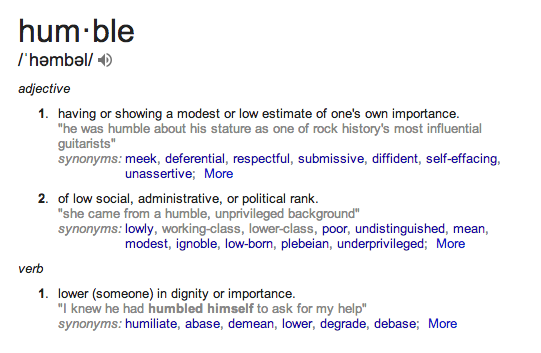
Teachers are a pretty humble lot. Most of us don't like to boast, stand in the spotlight or "toot our own horns." We quietly go about our work, and are both gracious and polite. I mean just look at the definition provided to us by Google Search...


Anything surprising? The definition seems to fit, I'm almost surprised that a picture of a teacher doesn't pop-up alongside it. I think our humility, at least in part stems from the fact that for so many of us teaching is much more than a career or profession. For many of us teaching is a vocation, a calling. Whether we chose teaching, or teaching chose us, we do it in service of others. This has had a profound impact on the professional culture, and I think it has, in part made us targets. I won't spend a lot of time in this post talking about the current state of education in this country, you can read about my thoughts regarding it, in my last post titled, Better Days. Let me be clear, I am not suggesting that we become a boastful lot, but I do think we need to challenge the idea of being humble, at least a little bit.

As noted in the definition provided by Google, humble is both synonymous with self-effacing, but it is also synonymous with meek, submissive and unassertive. This my friends, is where there is a problem. We need teacher leaders. We need educators that are bold, that are willing to stand up for the profession, advocate for students, take risks and tell the true story of education in this nation. We must do a better job of sharing our stories, the educational journeys we embark on with our students, the ways in which we have collaborated and pushed one another to innovate and improve the system, and we must celebrate the hard-work and dedication of our colleagues. If there was ever a time for meek, submissive and unassertive educators, that time has certainly passed. Now is the time for us to be bold, to speak up and speak out, and recognize our sphere of influence and the impact that we can have.

Speak Up...

I was truly honored this weekend to be nominated for a Bammy Award. The Bammy's are a powerful way that we can share our stories, support one another and celebrate all that is good in education. What is really great about these awards is that all of us can nominate our colleagues to receive recognition with the Educator's Voice Awards (learn more here). I nominated Steve Garraffo, LCSD Director for Elementary Education, for such an award. (This will take you to his nominee's page.) I think it is truly important for us to share all of the wonderful things that are happening here, and across the nation. I hope you will help spread the word, vote for some of the nominees, and nominate others. There are great things happening, and we have the responsibility to share them!


Wednesday, April 8, 2015

Better Days


If you were to listen to mainstream media, and any number of politicians, you might believe that education in our nation were in shambles. It simply isn't true. Are there struggles? Of, course. I'm not going to bury my head in the sand and pretend otherwise. The education system is not immune to society's ills, at times as a classroom teacher you see them amplified. Indeed, there are days when it seems almost too much to bear, and yet we do. We do, because teaching is more than a job. It is a deep calling, a vocation that can scarcely be put into words. We are committed to the young people, the families, the communities that we serve. We know their faces, their hearts, their stories.

There are days when I have wondered, and flat out worried about the direction of our nation. Competition, ranking, and sorting; it seems to bring out the worst in us. It is as if that we have forgotten that we are all ultimately connected to one another, and bound to one another. We have forgotten that for us to prosper as a nation requires collaboration, far more than it does competition. We must do better. There needs to be less isolation, and more connection. We must acknowledge our shortcomings, and look far and wide for ways to improve, we may have to admit that we don't have all the answers, and we need to be willing to make mistakes. We need to embrace curiosity, and cultivate wonder. We need to play, and infuse joy. This need not be a pipe dream, some pie in the sky ideals; no. We are the architects, the innovators, the creators, the voices that together must demand it, and make it so.

When I become discouraged by the state of affairs I do three things. First, I pray. I pray for strength, I pray for hope and I pray for faith. Second, I look at my own children, which strengthens my own determination and resolve. Third, I read my Twitter feed and am inspired and empowered by colleagues, many of whom I have never met. I believe in better days, and I believe in our power to make them better.